


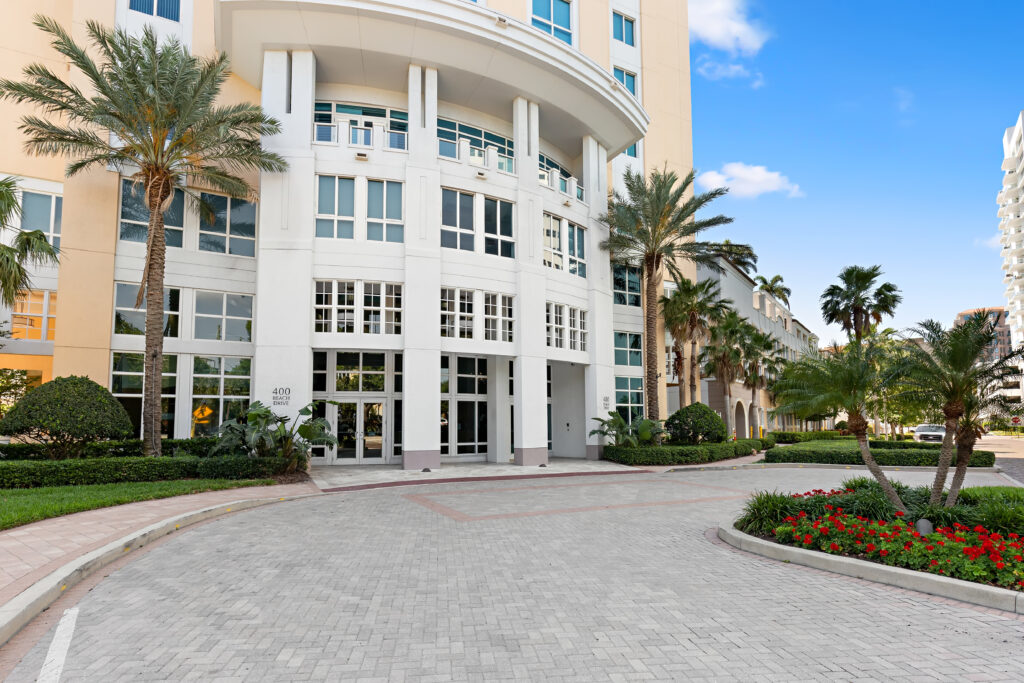
Buying a Condo in Downtown St. Petersburg: What to Know Before You Offer
If you plan to buy a condo in Downtown St. Petersburg, the building matters as much as the residence. Two units with almost identical square footage and views can carry very different monthly costs and resale prospects, depending on how the association is run.
This guide covers how downtown pricing is behaving now, what separates one tower from the next, which association documents to read, and the ownership costs that catch buyers out after closing.
Why the Downtown Median Is Close to Useless Right Now
Downtown St. Petersburg closes a relatively small number of sales in any given month, so the median can move dramatically depending on the mix of properties that happen to close.
The last two years illustrate the problem. In November 2025, Redfin’s downtown median sale price was $760,000, down 16% year over year, at $409 per square foot. Six months later, over the three months ending May 2026, the same median was $1.7 million, up 114.1%.
Downtown St. Petersburg did not suddenly more than double in value. Several new luxury towers began closing units, dramatically changing the mix of sales.
The more telling figure moved in the opposite direction: downtown price per square foot fell 14.3% year over year even as the median sale price rose sharply.
For a downtown buyer, the practical takeaway is simple: neighborhood averages should not determine your offer. What matters more are closed comparable sales within your target building, on comparable floors, with similar views and exposures, along with the building’s own price-per-square-foot trend.
Why Buyers Choose Downtown St. Petersburg
Downtown St. Petersburg is one of the few genuinely walkable urban cores on Florida’s Gulf Coast, sitting directly on Tampa Bay.
Residents can walk to Beach Drive restaurants, the St. Pete Pier, Museum of Fine Arts, The Dalí Museum, Mahaffey Theater and the bayfront parks. Central Avenue extends west from the waterfront into the EDGE District, adding restaurants, galleries, breweries and independent shops.
For many buyers, the practical attraction is lock-and-leave ownership. The association maintains the exterior, roof, grounds, pool and common areas, which can be particularly attractive to second-home owners, frequent travelers and people downsizing from single-family homes.
Choose a Downtown Condo Based on Your Priorities
Downtown is a relatively compact market made up of a limited number of buildings, and they are not interchangeable.
Deciding whether your priorities are water views, new construction, amenities, location or price per square foot can narrow the search considerably.
Beach Drive and the Waterfront
Buildings along Beach Drive overlook the bayfront parks, yacht basin and Tampa Bay.
The group includes 400 Beach Drive, Parkshore Plaza, Vinoy Place and The Nolen. Resale inventory along this stretch can be limited because several of the buildings are relatively small and owners often hold their residences for extended periods.
New Construction and Recent Delivery
Downtown St. Petersburg’s skyline has changed considerably.
The Residences at 400 Central is a 46-story tower with 301 residences and has become one of the city’s defining new buildings.
Art House, at 275 1st Avenue South, is a 42-story luxury tower with 244 residences.
Saltaire, completed in 2023, is a 35-story tower with 192 residences and an extensive amenity level.
ONE St. Petersburg, delivered in 2018, remains one of downtown’s signature luxury residential towers.
Waldorf Astoria Residences St. Petersburg has been announced as a 50-story tower with 163 residences, with completion reported for 2030.
Pre-construction buyers should remember that projected completion dates can change. Confirm delivery timing, deposit structure, escrow protections and what happens to deposits if schedules change before committing.
Established Towers Can Offer Value
Older downtown buildings frequently offer larger floor plans and lower prices per square foot than the newest luxury towers.
Signature Place is one of downtown’s most recognizable buildings. Bayfront Tower is among the city’s original residential high-rises. Smaller buildings including The Salvador, The Sage, Rowland Place and Reflection provide additional alternatives.
The trade-off is that older buildings generally have more structural, insurance and reserve history to investigate.
That due diligence isn’t a formality. Large repairs can translate into substantial special assessments for owners, even when a building remains structurally sound.
Understanding Today’s Downtown Condo Market
St. Petersburg is currently behaving like two different condominium markets.
New luxury towers continue attracting buyers and closing expensive residences, while resale condominium inventory has loosened considerably.
As of February 2026, Pinellas County single-family inventory was approximately 3.8 months, while condominium inventory was closer to 8.3 months.
That means condominium buyers generally have more negotiating leverage than single-family buyers.
But that leverage isn’t evenly distributed.
Older coastal and mid-century buildings are dealing with higher insurance expenses, structural reserve requirements and rising association fees. These are often the buildings where buyers have the greatest negotiating power — but also where they need to conduct the most careful due diligence.
What Downtown Condo Buyers Should Review Before Closing
Buying a condominium in Florida is fundamentally different from buying a single-family home.
You aren’t simply buying a residence. You’re buying into a shared balance sheet.
The association documents can tell you whether that balance sheet is healthy.
Check the Milestone Inspection
Florida’s milestone inspection requirements were created following the 2021 Champlain Towers South collapse.
In St. Petersburg, qualifying condominium and cooperative buildings three or more habitable stories tall generally must have a Phase 1 milestone inspection by December 31 of the year the building reaches 30 years of age, followed by inspections every 10 years.
If a Phase 1 inspection identifies substantial structural deterioration, a more extensive Phase 2 inspection follows.
For any building you’re seriously considering, obtain the inspection reports and determine what the association did in response to the findings.
Read the Structural Integrity Reserve Study
Separate from the milestone inspection is the Structural Integrity Reserve Study, or SIRS.
This may be one of the most important documents you review.
Florida law changed again in 2025. Among other changes, associations can under limited circumstances temporarily pause or reduce certain reserve contributions while funding repairs identified by a milestone inspection.
That means an association can potentially show relatively comfortable monthly dues today while facing significant financial obligations ahead.
Ask directly:
Has reserve funding been paused or reduced?
When does full funding resume?
Are major repairs planned?
Are special assessments being discussed?
What does the latest reserve study recommend?
Don’t simply ask whether the association “has reserves.” Find out whether those reserves are adequate for the work the building is expected to need.
Understand What the Monthly HOA Fee Actually Covers
Downtown condominium dues vary considerably.
A smaller mid-rise may charge a few hundred dollars per month, while residences in newer full-service luxury towers can pay well over $1,500 per month.
But the number alone tells you very little.
Compare what the fee actually includes:
Water, sewer and trash
Internet and cable
Building insurance
Parking or valet
Concierge and staffing
Amenity maintenance
Reserve contributions
A higher monthly fee in a well-funded association can ultimately cost less than a low monthly fee in a building that repeatedly funds major projects through special assessments.
Request the current operating and reserve budgets, prior-year actual expenses, recent board minutes, information about assessments under discussion and the association’s insurance information.
Review Insurance From Two Directions
The condominium association’s master policy generally insures the building itself.
You still need your own HO6, or walls-in, policy covering interior finishes, cabinetry, flooring and personal property, as well as appropriate loss-assessment coverage.
Flood exposure also needs to be evaluated building by building.
First Street data published through Redfin projects that 17% of Downtown St. Petersburg properties face severe flood risk over the next 30 years, compared with 45% across St. Petersburg as a whole.
But a neighborhood statistic doesn’t tell you the risk associated with a particular building.
An elevated residence may have very different direct flood exposure from the lobby, parking garage and mechanical equipment below it — and damage to those common elements can still affect owners through insurance deductibles, dues and assessments.
Check Rental, Pet and Approval Rules
Rules vary substantially between buildings.
Some associations impose minimum lease periods, limit the number of leases per year, require board approval of buyers or tenants, or restrict pets by size, number or breed.
If you plan to rent the residence seasonally or have a large dog, verify the current rules in the condominium documents rather than relying solely on listing remarks.
Property Taxes and the Real Cost of Ownership
Florida has no state individual income tax, but property taxes still need to be incorporated into your ownership budget.
More importantly, don’t assume the seller’s current property-tax bill will become yours.
Florida’s Save Our Homes provision can limit increases in assessed value for qualifying homesteaded property. Following a change in ownership, the assessed value can reset toward current market value.
For a long-held downtown property, the difference can be substantial.
Buyers should estimate their own taxes based on the anticipated purchase price rather than simply copying the seller’s existing tax bill.
Then calculate your complete monthly ownership cost:
Mortgage principal and interest
Association dues
Estimated property taxes after purchase
HO6 insurance
Loss-assessment coverage
Flood insurance, when applicable
Parking or storage fees
Potential assessments
The Condo Buying Process in Downtown St. Petersburg
Confirm Financing — and the Building
Getting personally pre-approved is only part of the financing process.
Lenders also evaluate condominium projects. Reserve funding, litigation, owner delinquencies, investor concentration and unresolved structural issues can affect whether a building qualifies for conventional financing.
In some buildings, cash or portfolio lending may be the more practical route.
Find that out before writing an offer.
Tour the Actual Unit on the Actual Floor
Views can change dramatically between the fifth and twenty-fifth floors, and north, south, east and west exposures can feel completely different.
Visit at different times of day when possible. Listen for elevator and mechanical noise and pay particular attention to afternoon heat and sunlight on west-facing glass.
A rendering or model residence isn’t a substitute for experiencing the actual unit.
Order Condominium Documents Early
Request the governing documents, financial statements, inspection reports and reserve information as soon as you’re under contract.
You want enough time to actually read them while you still have the ability to act on what you discover.
Inspect the Residence Too
A building’s milestone inspection doesn’t replace an inspection of your individual residence.
Inspect the HVAC system, water heater, plumbing connections, windows, sliding doors and evidence of previous water intrusion, particularly around balconies and exterior openings.
Why Local Knowledge Matters
Downtown St. Petersburg consists of a relatively small collection of buildings, each with its own association, financial position, rules, dues, assessments and resale history.
Real estate websites can show you asking prices and photographs.
They don’t necessarily tell you which associations are adequately funding reserves, which have assessments under discussion, which floor plans historically perform better on resale or which buildings may present financing challenges.
Tammy Campbell McNelis has lived in St. Petersburg her entire life and has been active in the local real estate market since 2006. She holds the Certified Luxury Home Marketing Specialist, Certified Negotiation Expert and Certified Home Marketing Specialist designations.
That building-level and neighborhood-level knowledge can be particularly valuable in a market where two seemingly similar condominiums can represent very different long-term ownership decisions.
Final Thoughts
Buying a condo in Downtown St. Petersburg is a decision about the building as much as the residence.
The unit determines much of your daily experience. The association determines a significant portion of your cost of ownership and your future resale position.
Read the milestone inspection and reserve study. Determine whether reserve funding has been paused. Understand what the monthly dues actually cover. Investigate assessments. Estimate your own property taxes and insurance.
And compare the residence you’re considering with actual closed sales inside that building — not simply the downtown median.
With condominium inventory currently providing buyers more negotiating room than the single-family market, there is an opportunity to be selective.
If you’re considering a condominium in Downtown St. Petersburg, Tammy Campbell McNelis and The CPM Luxury Team can help you compare buildings, analyze recent sales and understand the details that can make one downtown residence a much better purchase than another.
Frequently Asked Questions
Is Downtown St. Petersburg a good place to buy a condo?
Downtown St. Petersburg can be an excellent fit for buyers who want a walkable waterfront environment with relatively low-maintenance ownership. Residents can walk to Beach Drive, the St. Pete Pier, museums, restaurants, Central Avenue and the bayfront parks. The trade-offs include association dues, rules and shared responsibility for building expenses.
How much does a condo cost in Downtown St. Petersburg?
Recent downtown statistics have been heavily influenced by closings in new luxury towers. Rather than relying on the overall downtown median, compare closed sales within the specific building you’re considering, including similar floors, views, exposures and floor plans.
What are HOA fees like for Downtown St. Petersburg condos?
Fees range widely depending on the building and residence. More important than the headline number is what the fee includes and whether the association is adequately funding reserves. Compare the current budget and reserve study rather than simply comparing monthly dues between buildings.
What is a milestone inspection?
A milestone inspection is a structural evaluation required for qualifying Florida condominium and cooperative buildings. In St. Petersburg, the initial inspection generally occurs when a qualifying building reaches 30 years of age, followed by inspections every 10 years.
Can a condo association temporarily reduce reserve funding?
Under limited circumstances, yes. Florida law changed in 2025 to provide associations certain flexibility in reserve funding while addressing qualifying repairs. Buyers should ask whether an association has reduced or paused contributions, why it did so and when normal funding is expected to resume.
Do I need flood insurance for a Downtown St. Petersburg condo?
It depends on the specific building, flood zone, lender and insurance arrangements. The association’s insurance and your individual HO6 policy address different risks. Obtain building-specific and unit-specific insurance information before the inspection period ends.
Which Downtown St. Petersburg buildings should I consider?
Start with your priorities. Waterfront options include buildings along Beach Drive, while newer luxury towers include The Residences at 400 Central, Art House, Saltaire and ONE St. Petersburg. Established buildings may provide greater square footage for the money but can require more extensive investigation of reserves, structural history and assessments.
Important Disclosures
Market statistics and other information contained herein are obtained from third-party sources believed to be reliable, including Redfin, Zillow, Florida Realtors, Stellar MLS, the Suncoast Tampa Association of REALTORS, the Pinellas County Property Appraiser, the City of St. Petersburg, Pinellas County, the Florida Senate, First Street and local reporting. Accuracy, completeness and current applicability are not guaranteed. Market conditions and data are subject to change.
Nothing in this article constitutes legal, tax, insurance or investment advice. Florida condominium laws, inspection requirements and reserve requirements are subject to change. Association dues, budgets, reserves, insurance, flood zones, rental and pet rules, property taxes and building compliance are specific to each association and residence and should be independently verified.
Equal Housing Opportunity.