


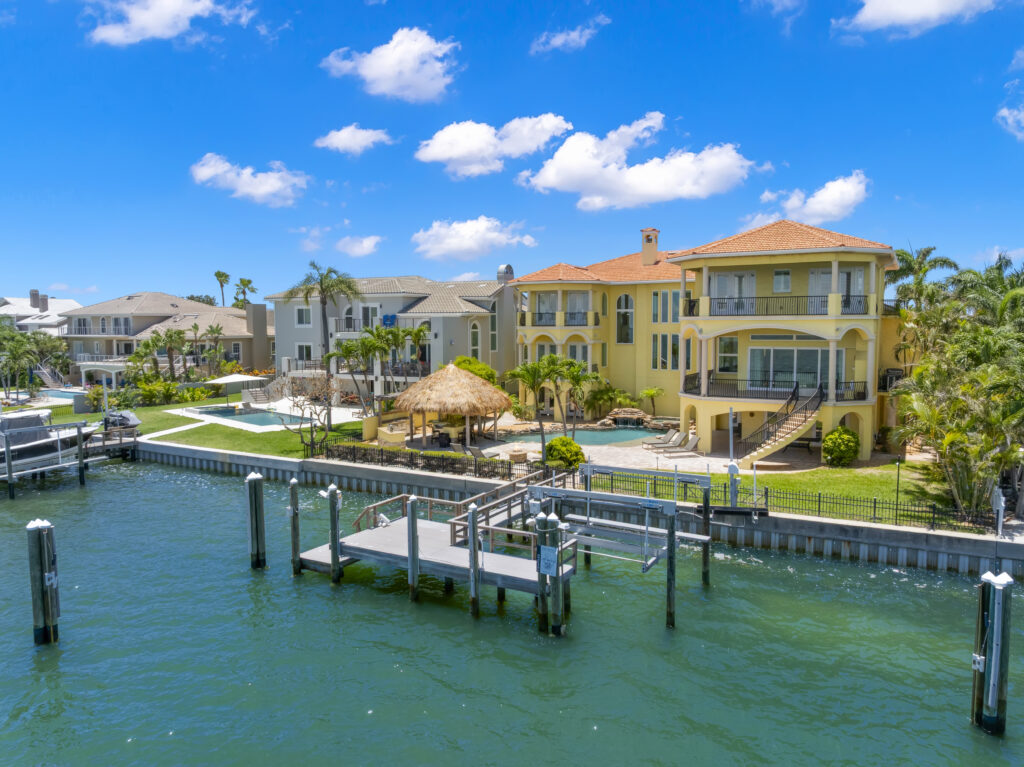
Learn how to buy a deep-water boating home in Tampa Bay by evaluating water depth, bridge clearance, docks, flood risk, taxes, and boating access.
Revision note: Draft for client review. Prepared for Tammy Campbell McNelis, The CPM Luxury Team. Revision 2, sourced and attributed. August 19, 2026. Substantial improvement thresholds made jurisdiction-specific and verified. Flood zone construction requirements, tax provisions, condominium reserve rules, and short-term rental requirements given specific sourced figures. Disclosures added.
How to Buy a Deep-Water Boating Home in Tampa Bay
Author: Tammy Campbell McNelis
Date Published: August 2026
If you want to buy a deep-water boating home in Tampa Bay, looking for a waterfront property with a dock is only the beginning. Serious boaters need to evaluate water depth, bridge clearance, canal width, dock capacity, seawall condition, flood exposure, and the actual route to open water.
Hurricane Helene in late September 2024 and Hurricane Milton in October 2024 also changed waterfront due diligence throughout Pinellas County. Flooding and storm damage made permits, insurance, elevation, and property history far more important when evaluating coastal homes, and the rules that govern rebuilding differ depending on which authority regulates the address.
This guide explains what buyers should investigate before purchasing a Tampa Bay boating property and how to determine whether a waterfront home truly fits their boating lifestyle.
What Makes a Deep-Water Boating Home?
A waterfront home is not automatically a deep-water boating property. The property needs to provide practical access for your current vessel and, ideally, any boat you may purchase in the future.
Before making an offer, verify:
Water depth at mean low tide, not at the moment you happen to visit
Bridge clearance along the entire route to open water
Canal width and turning radius
Dock length and beam capacity
Boat-lift capacity and piling condition
Shore power and freshwater connections
Seawall condition and remaining useful life
A seller’s description of “deep water” should never replace property-specific measurements and professional due diligence.
Can the home support your next boat?
One of the most useful questions for a luxury boating buyer is whether the property supports the boat you own today and the boat you may want five years from now.
A dock suitable for a 28-foot boat may not work for a 40-foot cruiser. A larger vessel may also require greater water depth, turning space, electrical capacity, and bridge clearance. A property that requires 20 minutes of idle-speed travel through narrow canals may be less desirable to an experienced boater than one offering five minutes of direct access to open water.
Where to Look for Deep-Water Boating Homes
Choosing the right location matters, but a waterfront boating property in Tampa Bay can offer very different boating conditions depending on its canal, water depth, bridge restrictions, and route to open water. Compare the actual boating experience rather than relying on neighborhood reputation.
Tierra Verde
Tierra Verde is an unincorporated Pinellas County community near Fort De Soto Park, developed from the 1960s around a canal system designed for deep-water access. Its position provides routes to Tampa Bay and the Gulf, but boating conditions vary from one canal to another.
Two points specific to Tierra Verde matter for this article. Because it is unincorporated, Pinellas County rather than a city administers floodplain rules, which means the stricter 49% threshold applies (source: Pinellas County). And flood exposure is near-universal: First Street data published through Redfin projects that 98% of properties face severe flood risk over the next 30 years, with 100% at extreme severe wind risk (source: Redfin). The island contains both AE and VE zones, so verify the designation for the specific parcel.
Venetian Isles
Venetian Isles offers canal-front homes close to Tampa Bay and downtown St. Petersburg. It is within the City of St. Petersburg, so the city’s 49% substantial improvement threshold applies (source: City of St. Petersburg). Venetian Isles was among the St. Petersburg neighborhoods significantly affected by Helene’s storm surge, so permit history and repair documentation deserve particular attention here. Verify the property’s individual navigation route, water depth, dock infrastructure, and seawall condition.
Snell Isle
Snell Isle combines luxury waterfront homes with convenient access to downtown St. Petersburg, and The Vinoy Golf Club sits on the island itself. Some properties offer excellent boating access, but conditions vary by location, making property-specific research essential. Snell Isle also experienced surge flooding in 2024, so ask directly about storm history and completed repairs.
South Tampa waterfront
Communities such as Culbreath Isles, Beach Park, and Davis Islands can also appeal to boat owners. Note that these fall under City of Tampa and Hillsborough County jurisdiction rather than Pinellas, so floodplain thresholds, permitting, and rental rules are different again. Compare actual boating access rather than choosing on the home’s size, views, or price.
How Helene and Milton Changed Waterfront Due Diligence
Storm history is now a critical part of buying waterfront property in Pinellas County. A buyer should determine whether the property experienced substantial damage, whether repairs were properly permitted, and whether a substantial damage determination was issued.
The substantial improvement and substantial damage rules require additional floodplain compliance when qualifying repair or improvement costs reach the applicable threshold. Reaching that threshold can mean the entire structure must be brought into compliance with current floodplain codes, which in practice can require elevating or replacing it. The threshold and the accumulation period differ by jurisdiction, and in this region they genuinely differ:
Unincorporated Pinellas County, including Tierra Verde, uses 49%. The county states that if repair costs reach 49% or more of the structure’s value without the land, the home is considered substantially damaged and cannot be repaired without being brought into compliance. All improvements are subject to the rule regardless of whether a determination has been issued, and the county provides an address lookup for existing substantial damage determinations (source: Pinellas County).
St. Pete Beach uses 50%, with a five-year lookback. Because nearly all properties there are in the special flood hazard area, the rule is enforced during plan review (source: City of St. Pete Beach), and permitted work from the previous five years counts toward the threshold (source: FOX 13 Tampa Bay).
The City of St. Petersburg also applies 49%. This covers addresses inside city limits including Snell Isle and Venetian Isles. The city’s Floodplain Management Ordinance Section 3.4 defines substantial damage as any combination of repair, reconstruction, or other improvement where the cumulative cost equals or exceeds 49% of the pre-damaged market value of the structure, with market value derived from the Property Appraiser’s office and an owner able to submit a state-licensed appraisal if they disagree (source: City of St. Petersburg).
Two mechanics catch buyers out everywhere. The denominator is the structure alone, valued without the land, which on a high-value waterfront lot can be a surprisingly modest figure. And owner labor is generally counted at market rates rather than at what the owner actually spent (source: The Gabber).
Ask these questions before closing:
Did the property receive a substantial damage determination?
Were post-Helene or post-Milton repairs properly permitted?
Are any permits still open, and were final inspections completed?
What repairs were completed after the storms, and by whom?
How much permitted improvement work in the applicable lookback period already counts toward the threshold?
Could planned renovations trigger additional floodplain requirements?
This information directly affects your renovation plans and future costs, and it is obtainable from the building department before you make an offer.
Check Flood Zones, Elevation, and Insurance
Review the property’s current FEMA flood zone, base flood elevation, elevation certificate, construction characteristics, and mitigation features.
The distinction between zones is practical, not academic. AE zones have an established base flood elevation and require the lowest finished floor at or above it. VE zones are coastal high-hazard areas where wave action is a factor on top of flooding, and compliant structures must be elevated on pilings or columns rather than slab or fill, with breakaway walls below the base flood elevation and structural elements engineered for wave loading. That difference materially affects what a substantial improvement will cost you if you cross the threshold.
On insurance, three figures are worth knowing before you shop. Standard Florida homeowners policies exclude flood, so flood is always a separate policy and windstorm is separate again. Federal building coverage is capped at $250,000, with contents covered separately and at a lower limit, and the average annual NFIP premium in Florida is about $1,363 against a national average near $1,290 (source: Insurify, citing FEMA). At luxury boating-home price points, private or excess flood coverage above the federal cap is generally necessary, and VE zone premiums run well above the state average.
Pinellas County holds a strong National Flood Insurance Program Community Rating System classification, which produces meaningful premium discounts for participating properties (source: NerdWallet). Classifications are set by individual jurisdictions, so confirm the discount that applies to your specific address. Request property-specific homeowners, windstorm, and flood quotes before the inspection period ends.
Inspect the Dock and Seawall
A standard home inspection does not fully evaluate a property’s dock, boat lift, seawall, underwater structures, or navigational suitability.
A specialized marine inspection should evaluate the dock structure, pilings, lift capacity, electrical service, shore power, seawall condition, erosion, cracking, settlement, tie-back systems, and remaining useful life. Seawall replacement in particular is a significant capital item that often falls entirely on the owner.
Request documentation for previous dock and seawall work. Depending on the property and the proposed improvements, permitting may involve local authorities, the Florida Department of Environmental Protection, or the U.S. Army Corps of Engineers. Existing dock size does not guarantee you can expand it later.
Consider Boca Ciega Bay Aquatic Preserve
Boca Ciega Bay Aquatic Preserve is a state-designated aquatic preserve covering much of the water between the barrier islands and mainland Pinellas, and it is a real consideration for buyers planning future waterfront improvements. Protected aquatic areas can affect proposed dock, seawall, and submerged-land projects, and state-owned submerged lands require separate authorization.
If you are buying a property specifically because you intend to enlarge the dock for a larger future boat, investigate the applicable environmental and submerged-land restrictions before assuming the improvement will be approved. The key question is not whether a dock exists today. It is whether the dock and surrounding waterway can support your long-term boating plans.
Evaluate the Actual Boating Route
The straight-line distance from a house to the bay tells you very little about how convenient the boating access will be.
Depending on the property, routes can involve Pass-a-Grille Channel, Blind Pass, John’s Pass, or other waterways. Depth, shoaling, bridges, tidal conditions, and manatee or slow-speed zones all affect actual travel time, and shoaling in particular changes over time.
Ask for controlling depth information rather than relying on a single advertised depth. Charted water depths reference a particular chart datum and do not represent the exact amount of water beneath the boat at every stage of the tide. Review current navigation information, and for larger vessels consider professional marine guidance before committing.
Don’t Forget Florida Property Taxes
Property taxes are an important part of waterfront affordability and belong alongside insurance and maintenance in your budget. The number that matters is not the seller’s current bill.
Florida’s homestead exemption reduces taxable value for qualifying primary residences. For 2026 in Pinellas County the exemption is up to $51,411, comprising $25,000 applied to all millages including school taxes plus an additional $26,411 applied to non-school millages, because the second tier is inflation-adjusted (source: Pinellas County Property Appraiser). Save Our Homes then limits annual assessment increases on qualifying homesteads to 3% or the change in the consumer price index, whichever is lower.
A change of ownership resets that protection. The Property Appraiser notes that the exemption is not automatically applied when a buyer moves from a prior homestead, so the new owner must apply, and the property benefits from the Save Our Homes cap only in the second year of the new owner’s exemption (source: Pinellas County Property Appraiser). On a long-held waterfront home the increase can be substantial (source: Pinellas County Property Appraiser).
Buyers moving between Florida homesteads may port accumulated benefit, up to a maximum of $500,000. Moving to an equal or higher-valued homestead allows the entire benefit to transfer up to that cap, while downsizing transfers a proportional share, and applications are due by March 1 of the year claimed within a three-year window (source: Pinellas County Property Appraiser). Second-home and investment-property buyers receive neither the homestead exemption nor the Save Our Homes cap, which matters because many boating homes are not primary residences.
Model your own first full year using the Property Appraiser’s tax estimator, which accounts for portability (source: Pinellas County Property Appraiser).
Waterfront Condos Require Extra Research
If you are considering a waterfront condominium with dock or marina access, the building’s condition and finances matter as much as the residence.
Qualifying buildings three or more habitable stories tall must complete a milestone structural inspection by December 31 of the year the building reaches 30 years of age, then every 10 years, and Pinellas County publishes this threshold for unincorporated areas under a local ordinance (source: Pinellas County). An earlier statewide 25-year trigger for buildings within three miles of a coastline was removed by Senate Bill 154 in 2023, though local agencies retain discretion to require 25 years (source: summary of SB 154).
The reserve rules changed in 2025 in a way buyers should understand. House Bill 913, effective July 1, 2025, raised the reserve threshold for additional items from $10,000 to $25,000 and allows an association that completed a milestone inspection within the previous two years to temporarily pause or reduce reserve contributions for up to two consecutive annual budgets in order to fund repairs the inspection identified (source: Florida Senate, HB 913). A building can therefore show comfortable dues with a substantial obligation ahead of it.
Review:
Milestone inspection documentation, including the full history
The structural integrity reserve study
Current reserve funding, and whether contributions have been paused
Current and proposed assessments
Building insurance and the insurance appraisal
Major repair plans, including any dock, seawall, or marina work
Also confirm the building is financeable through your lender before writing an offer, since lenders review condominium projects separately from borrowers.
What About Short-Term Rentals?
If the property will be used as a vacation or investment rental, investigate the rules for the specific parcel before purchasing. The differences between neighbouring jurisdictions are substantial.
In unincorporated Pinellas County, including Tierra Verde, a county ordinance adopted in 2025 applies to properties rented for fewer than 30 days at a time more than three times per year. Owners must obtain a Certificate of Use and comply with safety, occupancy, parking, and noise requirements including quiet hours from 10 p.m. to 9 a.m. (source: Pinellas County).
St. Pete Beach is considerably more restrictive. Short-term rentals of less than one month are not permitted in many districts, and the city allows transient occupancy of less than 30 days only up to three times per 12-month period in the RM zoning district and in properties within the Pass-a-Grille Overlay District. Rentals of one month or more are permitted in all residences citywide (source: City of St. Pete Beach).
The City of St. Petersburg restricts short-term rentals through its own zoning and licensing framework, and South Tampa properties fall under separate City of Tampa and Hillsborough County rules. State and county requirements also apply on top of local zoning, including a Florida Department of Business and Professional Regulation vacation rental licence for qualifying rentals, a local business tax receipt, and tourist development and sales tax registration. A jurisdiction-by-jurisdiction summary is maintained by the local REALTOR association (source: Suncoast Tampa Association of REALTORS).
Homeowner association and condominium documents may impose stricter restrictions even where local regulations permit an arrangement. Never assume a waterfront home can legally operate as a short-term rental because neighbouring properties appear to do so.
Calculate the Complete Cost of Ownership
The purchase price is one part of owning a deep-water boating home. Budget for:
Property taxes, using the reset estimate rather than the seller’s bill
Homeowners, windstorm, and flood insurance, including excess flood above the federal cap
Dock and lift maintenance
Seawall repair or replacement reserves
Association or condominium fees
Potential special assessments
Storm-hardening improvements
Closing costs are worth modelling too. Florida imposes documentary stamp tax on documents transferring an interest in real property, at $0.70 per $100 of consideration or portion thereof in all counties except Miami-Dade, plus $0.35 per $100 on promissory notes and a separate intangible tax on recorded mortgages (source: Florida Department of Revenue). On a $3 million purchase the deed tax alone is roughly $21,000. Customary allocation between buyer and seller varies and is negotiable, so confirm the actual amounts and who pays what with your title company or closing professional.
Common Mistakes to Avoid
Assuming every waterfront home has deep-water access
A waterfront listing does not guarantee sufficient depth, turning space, or bridge clearance. Verify the entire route for your specific vessel at low tide.
Ignoring storm and permit history
After Helene and Milton, investigate substantial damage determinations, repair permits, and how much prior permitted work already counts toward the applicable threshold. Confirm which threshold applies: the City of St. Petersburg and unincorporated Pinellas County both use 49%, while St. Pete Beach uses 50% with a five-year lookback.
Planning for a bigger boat without checking
Your current boat may fit while your future vessel may not. Evaluate depth, dock capacity, lift capacity, bridge clearance, and turning radius before purchasing, and confirm whether dock expansion is permittable.
Relying only on a standard home inspection
A standard inspection does not replace specialized dock, seawall, lift, piling, or marine inspections, and it will not tell you anything about navigability.
Final Thoughts
To buy a deep-water boating home in Tampa Bay, evaluate more than the house. Water depth, bridge clearance, canal width, dock capacity, seawall condition, storm history, flood zone and elevation, insurance, taxes, and permitting all determine whether a property is right for you.
The 2024 hurricanes changed waterfront due diligence in Pinellas County. Buyers now need to understand substantial damage thresholds, post-storm permits, and floodplain rules, and to recognise that those requirements differ between St. Pete Beach, unincorporated Pinellas County, and the City of St. Petersburg.
If you are evaluating boating homes in Tierra Verde, Venetian Isles, Snell Isle, South Tampa, or another Tampa Bay waterfront community, The CPM Luxury Team can help you evaluate the property’s location, boating characteristics, permit history, and overall fit.
Frequently Asked Questions
What is a deep-water boating home?
A deep-water boating home provides practical water access for a specific vessel without major tidal, bridge, canal, or navigational limitations. Verify depth at mean low tide, bridge clearance along the whole route, turning radius, dock and lift capacity, and the complete route to open water rather than relying on a listing description.
What should I check after Hurricanes Helene and Milton?
Ask whether the property received a substantial damage determination, whether storm repairs were permitted and closed with final inspections, and whether planned improvements could trigger current floodplain requirements. Confirm which threshold applies: unincorporated Pinellas County uses 49% (source: Pinellas County), while St. Pete Beach uses 50% with a five-year lookback (source: City of St. Pete Beach).
Why does the 49% versus 50% difference matter so much?
Because the threshold is calculated against the structure’s value excluding the land, and on a valuable waterfront lot the structure may represent a modest share of the purchase price. A renovation budget that is comfortably compliant in one jurisdiction can trigger a full floodplain compliance requirement a few miles away, which may mean elevating or replacing the structure. Confirm the threshold and the accumulation period with the governing authority before scoping any project.
How much flood insurance can I actually get?
Federal flood insurance caps building coverage at $250,000, with contents covered separately and at a lower limit (source: Insurify, citing FEMA). Buyers at luxury boating-home price points generally need private or excess coverage above that cap, and should obtain quotes for the specific address before the inspection period closes. Windstorm coverage is a separate policy again.
Can the seller’s property-tax bill tell me what I will pay?
No. Florida’s homestead exemption and Save Our Homes provisions can make the seller’s assessed value very different from what applies to a new owner, and the exemption must be applied for rather than inherited (source: Pinellas County Property Appraiser). Use the Property Appraiser’s tax estimator to model your own first full year (source: Pinellas County Property Appraiser).
What should I inspect on a waterfront property?
Inspect water depth, boating route, bridge clearance, canal width, dock, pilings, boat lift, shore power, seawall, tie-back system, permits, flood zone, elevation, and storm history. A specialized marine inspection should supplement the standard home inspection, because a standard inspection covers neither the waterfront infrastructure nor navigability.
Are waterfront condominiums different?
Yes. Review milestone inspection reports, the structural integrity reserve study, reserve funding, special assessments, insurance, and planned repairs. Ask specifically whether reserve contributions have been paused, which House Bill 913 permits in limited circumstances for associations that recently completed a milestone inspection (source: Florida Senate, HB 913).
Can I use a Tampa Bay waterfront property as a short-term rental?
It depends entirely on the parcel. Unincorporated Pinellas County permits short-term rentals with a Certificate of Use (source: Pinellas County), while St. Pete Beach limits stays under 30 days to three per 12-month period and only in the RM district and Pass-a-Grille Overlay District (source: City of St. Pete Beach). Association documents can be stricter than local rules.
Can I enlarge an existing dock?
Not automatically. Dock and seawall improvements can require local, state, and federal approvals, potentially including the Florida Department of Environmental Protection and the U.S. Army Corps of Engineers, and aquatic preserve designation or state-owned submerged lands can affect what is permittable. Investigate existing permits and confirm feasibility before purchasing on the assumption of expansion.
Important Disclosures
Market statistics and other information contained herein are obtained from third-party sources believed to be reliable, including Redfin, Pinellas County, the City of St. Pete Beach, the City of St. Petersburg, the Pinellas County Property Appraiser, the Florida Department of Revenue, the Florida Senate, the Suncoast Tampa Association of REALTORS, FEMA, First Street, and local news reporting. Accuracy, completeness, and current applicability are not guaranteed. Market conditions, insurance costs, and regulatory requirements are subject to change, and each figure reflects the reporting period stated beside it rather than present-day conditions.
Nothing in this article constitutes legal, tax, insurance, engineering, marine surveying, navigational, or investment advice. Descriptions of substantial improvement and substantial damage thresholds, floodplain management and flood zone construction requirements, dock and submerged-land permitting, short-term rental regulations, condominium milestone inspection and reserve study requirements, property tax provisions, and documentary stamp tax are general summaries current as of the publication date. These requirements are administered by local, state, and federal officials, have been amended repeatedly, and are subject to change and to interpretation that varies by jurisdiction. Charted depths, controlling depths, and bridge clearances are published for navigational reference and do not represent conditions at every tide or in all circumstances; they must not be relied upon for navigation. Flood zone designations, base flood elevations, elevation certificates, insurance premiums and availability, permit history, substantial damage determinations, structure values, dock and seawall permits, association dues and reserve positions, rental eligibility, property tax amounts, and closing costs are specific to each property and must be independently confirmed. Readers should verify permit and floodplain status with the governing authority, verify flood zone information with FEMA, verify navigational information with current official sources, obtain a qualified marine survey, and consult qualified legal, tax, insurance, engineering, and appraisal professionals before making any real estate decision.
Equal Housing Opportunity.